

Belongings and ancestors, stored and confined in vitrines, cellars and depots of institutions, museums, or even private homes are often perceived as non-living objects. This perspective overlooks the deep connection, exchange, and interdependency that exists between us and those belongings and ancestors, even when we sometimes do not know who they are, where they come from, and to whom they belong today. How can we understand connections between ourselves and others, between human and non-human beings, beyond the logic of ownership? How can we unlearn the binary divisions that we were taught and have internalized?
Within my artistic vocabulary, water and braids serve as symbols for addressing interdependencies, relationships, and the processes of identity formation in constant transition. Through these elements, I explore our ability to understand such ties through practices and gestures, expanding our rational understandings of how we relate to one another. By working with performance and creating visual scenes that incorporate various textiles and techniques, I focus on moments of transition and change. I am interested in forming spaces where borders and definitions become blurred, and where potentialities can be explored through context, movement, and gesture—creating a vocabulary for what could be. Reflecting the workings of memory—fragmented, jumping back and forth, not following our understanding of linear time—this text does not follow a chronology or aim to present an overarching narrative that explains a certain development. It is a rehearsal to understand what the images and gestures of these works mean, to become conscious of their connectedness through the elements of braids and water. I think of the method Gloria Anzaldúa calls “el cenote/the dreampool,” through which she describes ancestral information stored as imagery in our individual and collective unconscious.[1] Tapping into these images can be a creative and spiritual way to create and reconnect to knowledge. I understand my videos and performances as expressions of the images stored within us that are connected to collective imaginaries we can explore in our search for meaning.
These reflections stemming from my artistic research are part of the Repatriates project, which investigates the role art plays in multifaceted repatriation processes. After my research led me to cases where repatriation was impossible due to unlocated remains—such as Pocahontas’s burial place in Gravesend, England—I shifted my focus. I then examined the influence of the imaginary realm and stereotypes, arguing they shape not only museum policies and narratives, but also the way we understand ourselves within culture and national narratives. Exploring how shared images and imaginaries connect us has been central to my inquiry into their impact on institutional decisions, gestures, narratives, and, more broadly, collective identity.

Trenzación (2017). Berlin, in the City and the Woods. Direction, Camera, and Performance: Maque Pereyra and Verena Melgarejo Weinandt.
Maque and I stand in the woods. Our long hair is intertwined, creating a shared braid. Together, we burn a plait of our cut hair. This gesture represents the beginning and end of our performative ritual. In between, meter-long braids are dragged through the streets of Berlin, and we comb each other’s hair, braiding and unbraiding it.
We change our hair constantly—it is cut, bleached, and dyed. Every transformation, every change, creates its own moment of authenticity; there is no original state, no past that needs to be preserved. The braids only create meaning through their connection to life. In photos of my great-great-grandmother Bacilia when she was young, she is wearing her two braids. I remember how she stands proudly next to her husband and looks directly into the camera. In older pictures, she is no longer wearing her braids. Cutting off one’s braids is a strong symbol of identity transformation in relation to the migratory experiences of Indigenous people, especially women, in Bolivia. Many Indigenous women cut their braids when they move to urban areas to look for work or simply to face less discrimination by assimilating into Bolivian mestizo society.
Our hair forms a bond with our ancestors. Their braids tell a story; they are an expression that resonates in the present, and continues to create what will be. In our performance, the plait and the act of braiding become metaphors for the social and political implications of identity formation—an organic movement and process in which connections and commonalities might be able to transform our world.
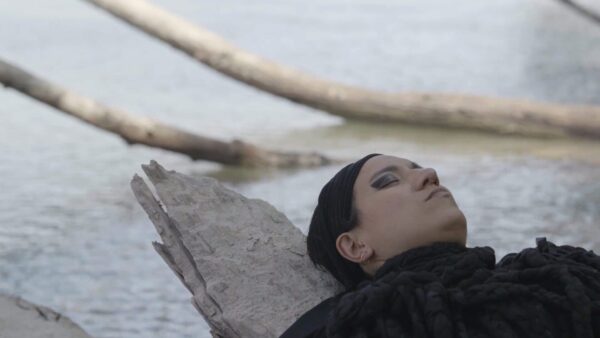
Transformation. Braiding Renewal (2023). Next to the Danube, Kritzendorf, Austria. Camera: Nick Prokesch. Assistant Director and Camera: Liesa Kovacs. Costume: Yvonne Kaufmann and Verena Melgarejo Weinandt. Director and Performer: Verena Melgarejo Weinandt.
On the riverside, I weave a cloak out of many plaits, place it around my shoulders, and walk into the water, where I wash the braided garment. Stereotypes and fantasies about Indigenous people in German-speaking contexts have a long history and continue to weigh heavily on our present, like the braids I pull across the sand and into the Danube. Do we all feel the burden of the past pressing on our shoulders? What can we possibly do with it? Perhaps it helps to manifest the weight, to represent it, to make it perceptible and allow it to be experienced. Perhaps then we can set it on a path of transformation, where it travels with the currents and tides, becoming something new.
Trenza Video (2015). Vienna. A collective production of Trenza.
We are a group of women, first- and second-generation migrants from different parts of Abya Yala.[2] We formed the collective Trenza (“braid” in Spanish) to interlink our experiences, creating a common thread that supports our stories and connects them to a longer strand. “We don’t want to be / Stars but a parts / of constellations,” as Gloria Anzaldúa says.[3] In a collective performance, we filmed our hands braiding dough and decorating it with flowers, seeds, and herbs.
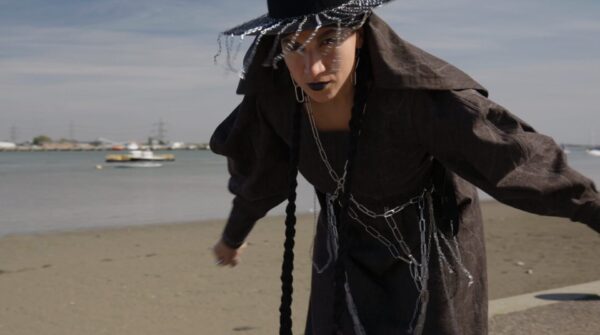
Tinku. Encounter-Confrontation (2025). Next to the Thames, Gravesend, England. Camera: Nick Prokesch. Assistant Director: Liesa Kovacs. Director and Performer: Verena Melgarejo Weinandt.
The folkloric Bolivian dance Tinku refers to a ritual practiced in the Potosí region that involves eating, drinking, and dancing—though its central activity is a fistfight between community members. This fight is seen as part of a collective effort to restore equilibrium not only within the community but also for Mother Earth.
I learned Tinku in Bolivia at the age of nineteen. In this work, I perform it beside the River Thames. Pocahontas was brought to London via this river, where she was used to promote the tobacco industry in the colony of Virginia. Countless variations of her story have been told, but not many people know what really happened to her. In 1617, she died on the ship that was taking her back to her homeland, and was buried in the ground of St. George’s Church in Gravesend, a small town forty-five kilometers from London. She has never been able to complete the journey down the Thames and across the ocean. The location of her remains is unknown, since a fire destroyed the church in 1727. However, she is still present and connected with us in different ways, whether through her real persona and life story or the many fictional versions of her. Reflecting on the histories that shape us prompts a number of questions: How can the violence that circulates through invented stories and images be addressed? How can this discrepancy between reality and fantasy be made tangible?
Alongside the Thames, I swing my braids through the air. As I dance, I turn in a circle, stomping the ground, my fists following the motion of my body, punching in different directions, sometimes directly toward the camera. My body, dance, and movements try to manifest in this place of contradictions and tensions what cannot be expressed in words: connections that move across the seas, that drift between reality and fiction, that connect us with beings of the present and the past—that entwine us all, in one way or another.
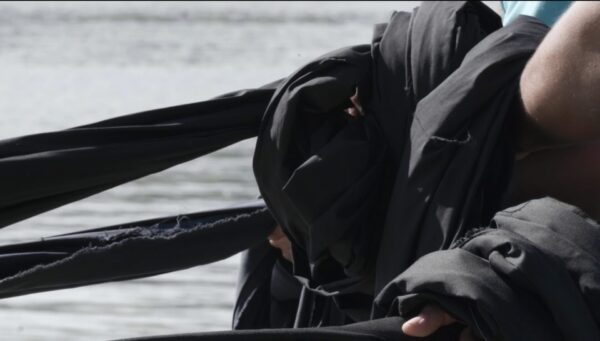
Weaving Connections, Ocean Space, Venice (2026). Commissioned and produced by TBA21- Academy. Next to the Danube, Vienna. Performers: Alfredo Ledesma, Marisel Orellana Bongola, Auro Orso. Camera: Nick Prokesch and Miae Son. Shooting Assistant: Pêdra Costa. Sound: Bassano Bonelli. Concept and Direction: Verena Melgarejo Weinandt.
I have known Alfredo, Marisel, and Auro for many years. They have all grown up or currently live in Vienna, recognize their Indigenous ancestors, and have artistic practices that address different axes of violence—such as racism or class- and gender-based—while searching for a collective and spiritual equilibrium.[4] Our lives and artistic practices have intertwined at different moments in our lives, influencing one another’s thinking, feeling, and doing. In this performance, they tear black fabric into strips together, weaving them into one long, shared black braid, which they then wash in the river, connecting it with the water. The tearing of the fabric makes a harsh noise, but the movement is calm and concentrated. They tear simultaneously, each person following their own rhythm.
Interweaving is a collective gesture—it requires us to wait for one another, to let each body understand and do what is necessary without speaking. The fabric strands intertwine with arms and legs, with the water and the sand, while the braid grows longer and longer. Both the performance and the braid are in the water, following and adapting to its movement, to its fluidity. A gesture, an involvement, is required to establish a connection with the water; it is a process, an activation. Water flows, always in motion—it constantly transforms, much as we do.
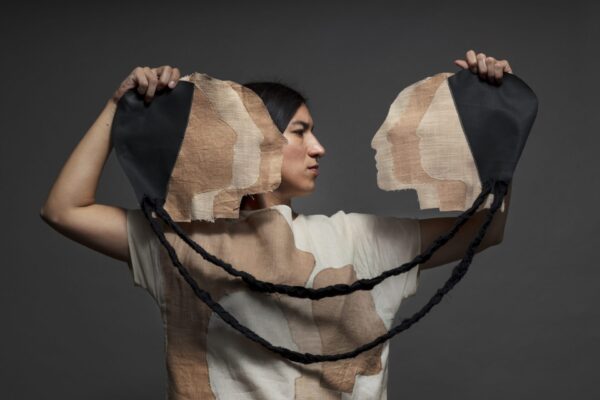
Entretelas_Interfaces (2017). Berlin. Textile Installation and Performance-Photography.
I am sewing gestures of transformation. I am making faces, sewing faces, sewing them onto dresses. Hair and braids frame my own face and my sewed faces. I am referencing Gloria Anzaldúa’s book Making Face, Making Soul (1990). In it, she describes an in-between space where resistance becomes possible—a space that allows one to reflect on one’s own face. From this perspective, we understand which faces are essential, which remain part of the self, which are strategic, which are useful, and which can be discarded as unnecessary. Anzaldúa refers to this in-between space with the metaphor of a specific type of fabric: an interface that provides support but isn’t visible, usually sewn to the underside of the fabric. Here, the process of making and unmaking is revealed—the interface is turned outward. Exploring this space, braids become part of faces, different textile elements are joined to the body, gestures are explored that protect, reflect, and provide support.
@all images: Copyright Verena Melgarejo Weinandt, all rights reserved.
Verena Melgarejo Weinandt is a German Bolivian artist, researcher, curator, and educator. She is currently a project manager and artistic researcher for the project Repatriates at the Central European University, Vienna, funded by the European Research Council. Previously, she was a researcher at the University of the Arts Berlin in the research group “Knowledge in the Arts” funded by the German Research Foundation. She has taught at the Academy of Fine Arts Vienna, the University of Applied Arts Vienna, and the Inter-University Centre for Dance Berlin. Her current artistic research as part of Repatriates focuses on the significance of Indigenous stereotypes in the German-speaking context and how they shape cultural and institutional practices, as well as our relationship to fictional, imagination, and nonhuman beings as a tool for (re)creating both individual and collective identity. Since 2015, she has organized workshops, exhibitions, publications, and educational programs on the writer and theorist Gloria E. Anzaldúa.
[1] Gloria E. Anzaldúa, Light in the Dark / Luz en lo oscuro: Rewriting Identity, Spirituality, Reality (Durham, NC: Duke University Press, 2015), 242.
[2] Abya Yala is a term referencing Latin America that was used by the Kuna people before colonization. It can be translated as Mature Land, Living Land, or Flowering Land.
[3] Gloria Anzaldua, “The New Speakers,” in The Gloria Anzaldúa Reader, ed. AnaLouise Keating (Durham, NC: Duke University Press, 2009), 24–25.
[4] I use equilibrium instead of healing, which I feel has become overused and emptied of meaning in academic discourse. In Western contexts, healing is the response to a sickness, the reestablishing of a “healthy” condition. To me, the term equilibrium helps convey that this is not a binary situation but rather an process of transformation and integration.