

The word ngeniyerriya expresses an insatiable nostalgia felt by the Anindilyakwa people—for the past, memory, and their homelands. As Traditional Owners of the Groote Archipelago, their lives have changed greatly over the past hundred years, from traditional hunting and gathering to a way of life shaped by outside influences and modernity. It is within the feeling of ngeniyerriya that memories are held, and where the knowledge and existence of the people lie. We look toward this “long time ago,” working to document and keep stories alive so that the passage of time does not stain them.
____
The gentle lapping of waves receded in constant rhythm upon the white sand where Umbakumba, a remote Indigenous community on Groote Eylandt, softly meets the sea. Postcard palm trees arranged themselves around the bay, stretching into the distance. We are on an island in the tropics of northern Australia.
The oldest lady in Umbakuba, Edith, sat in the warmth of the shade beneath a tin overhang. She cast her gaze across the bay, her bay. A place where fish occupy the deep and claws scuttle in the shallows. I, a filmmaker, had come to record a story, and I made tea, memories stirred in tea. I was with Edith’s grandson, Albertson, a filmmaker himself; he brought Edith support and an Anindilyakwa audience to hear her words
Edith’s life had witnessed the arrival of missionaries, mining, tinned food, and Toyotas. Memories transferred to Edith from her grandmother’s time made her a treasure trove of atavistic knowledge—a living cultural continuum. She had a fondness for filming and could turn words into brilliance; the old lady was a gift to storytelling.
Dadikwakwa-kwa, or shell dolls, had been dormant for decades; some were in institutions, and surface-level details existed only in field notes. A repatriation of dadikwakwa-kwa from a collection at Manchester Museum had inspired conversations, and some Anindilyakwa artists began creating contemporary versions. There were minute details around their use, and we had been directed, as usual, to see the old lady Edith to get the full story of the dadikwakwa-kwa.
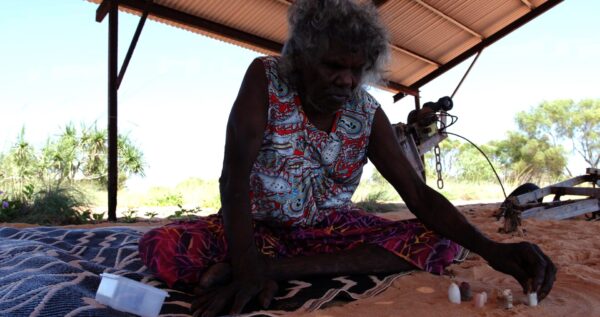
The consumption of tea suggested readiness, and I wondered what may unfold. I nodded to begin, and Edith busily smoothed a patch of sand in front of her. From a small woven bag she drew the dadikwakwa-kwa, one by one, assigning name and extending kinship to the dolls. It was a lesson in family structure, a genealogical chart, the topography of sand.
Men were simple sticks, unadorned, upright. The women, by contrast, were detailed, painted with motifs in ochre, wearing cloth or woven fibers. The children sat in clusters, watched over by mothers and aunties. The scenes mirrored life; they were drawn from lived experience, camp life, social structures, long journeys. Narrative interwoven with cultural customs and compunction. Each figure was a mnemonic, etched in her memory from when she was a young girl, on this beach, arakba-wiya, a long time ago. We could see she was enjoying herself. When the stories ended, Edith put the dadikwakwa-kwa to sleep and smiled.
The dolls were emblems of the memory of her grandmother, a deep connection to her stories told with sand and shell more than seventy years ago. The bond with the dadikwakwa-kwa was so significant that Edith buried her childhood dolls’ garments, gifts from her grandmother, alongside her grandmother when she passed away. It was a climactic revelation, unearthed during recording. The old lady had “brought moonlight into the chamber” in a storytelling sense, illuminating the influence the dadikwakwa-kwa had on her and linking the memento in cloth form with the life of her grandmother.
Edith had breathed life and meaning into the dadikwakwa-kwa, sparking a global resurgence of the practice. The film we made, Dadikwakwa-kwa-Alawudawarra (2023), inspired a new generation of artists to create and reimagine their dadikwakwa-kwa. As they arrived on the tide lines, they were hand-picked, painted, clothed, and carried by granddaughters, laying new stories in the sand.
Now they travel, like the shells they once were, carried on tides across the country and the world. People are captivated by their meaning, by their life. Anindilyakwa women are proud to share their culture in workshops, galleries, and museums. Edith’s film remains a guide; the feelings that day were passed on.
Films like these, capturing knowledge with lasting impact, lie at the heart of what we do. I have worked with the Anindilyakwa people for six years in a cultural space guided by their desire to record and preserve heritage. It is a media-culture program, offering elders and knowledge holders a platform and giving Anindilyakwa filmmakers the chance to express themselves through the moving image.
The small team of Anindilyakwa film workers is central to the responsibility of documenting culture. They provide oversight and guidance in our daily work. Directors like Albertson, Edith’s grandson, along with translators and editors, shape the language and direction of each project. They act both as filmmakers and as audience, ensuring that culturally significant moments are recorded with care.
We film in the Anindilyakwa language as much as possible. The language holds knowledge and comes from the land. It is a world-giver for the Anindilyakwa people, and like all Indigenous languages, it is at risk. Contributing to a growing body of work in the traditional tongue is vital to its preservation.
Anindilyakwa stories can follow different structures, and my approach to cultural documentation is to record stories the way they are told.
Connection to land is embedded in introductions; kinship announcements come next. The details must remain, as the viewer needs them to place themselves in relation to the orator, to be assured by their link, their belonging to the story. These stories often contain circular elements; they repeat, and through repetition, they emphasize.
Creation stories, known as Dreamtime stories, are nebulous, leaping through time and place, rarely following a linear structure. Their ambiguity is deliberate; all is not revealed. They are an invitation to interpret. These stories work best as whole forms, not as raw footage to be cut, but as complete expressions. Editing them can interrupt or alter important details, so I leave them whole, as if the viewer were present, listening to the orator.
It is delicate work, the world we work in. Culture is a spiritual connection, deeply personal. The screen is flat, and the camera is an outsider, unforgiving. I am always conscious of the presence of the camera, of how it can alter the mood or affect a moment. I withdraw if necessary; the camera can always be put away. Some experiences are best lived off camera. Some stories never make it to tape, and there is weight in experiences lived off camera.
The acceptance of our work is evident in our offices, living spaces of overlapping creativity, ideas, and access. Films flow across dilatory waves through Bluetooth, we fill USBs that fill televisions with films, and the internet carries our work further still. Our films are aired in classrooms, enriching lesson plans with the local language and the knowledge of ancestors. The students are engaged, and the classrooms open to the environs they inhabit.
Time is ethereal, and stories that might otherwise disappear into it are caught and preserved. The older generation grows older, and with them, knowledge risks being lost. There is urgency in this work. This realization of a life nearing its end is heartfelt, explained to us with clarity and care by the elders. We record and house these words for descendants, digital keepsakes entrusted to the responsibility of the archives. A place that Anindilyakwa people present and future can watch and recognize themselves in.
____
I would always say a slow goodbye to Edith with an extended gaze, never knowing which farewell might be our last.
She would look at me and say:
“Come back when you need more stories.”
And then, one day, she left this earth.
At her funeral, Edith’s family invited me to honor her filmic work with a eulogy. I named the countries where her stories had traveled, to film festivals and museums around the world, and thanked her for the time we shared. Understanding the reach and significance of her work, her family granted a rare permission: for her image and voice to remain in her films during the mourning period. This was an extraordinary gesture in Aboriginal protocol. For Anindilyakwa people and a global audience, her stories would continue to be told.
____
These days, as I sit with the old ladies, slightly younger old ladies than Edith, they chat about when they were young and the dadikwakwa-kwa they are working on. As Dolly Parton plays in the background, one of the ladies turns to me and says:
“That old lady Edith had a story about the dadikwakwa-kwa.”
I nod, waiting for what might come next.
“It’s on YouTube,” she says. I smile.
Ediths words nourish the landscape, and I still feel them in places we had been together. Now other stories continue, and the films remain.
Britten Syd Andrews is an Australian filmmaker and photographer with over a decade of experience working closely with Indigenous communities. He is currently the media coordinator for the Anindilyakwa Land Council. Guided by Traditional Owners, the media program documents important stories, traditions, and language, helping to preserve the cultural identity of the Anindilyakwa people for future generations. In 2023, Andrews documented the repatriation journey of 174 cultural heritage items from Manchester Museum back to Groote Eylandt. He accompanied an Anindilyakwa delegation in partnership with the Australian Institute of Aboriginal and Torres Strait Islander Studies (AIATSIS), capturing the significance of this moment in his film Engku-Wa Angalya (Far Away from Home, 2025).
Edith Mamarika (1945–2024), a senior Warnindilyakwa artist, elder, and cultural knowledge holder from Umbakumba on Groote Eylandt, is known for her traditional and contemporary weaving using both pandanus and ghost nets, and for her shell necklaces. She is also recognized for her role in the repatriation of cultural artifacts. She shared memories of playing with some of the returned items, like the dadikwakwa-kwa shell dolls, with her grandmother.
Anindilyakwa Arts is a thriving hub of creativity spanning the Groote Archipelago in the Gulf of Carpentaria, Northern Territory. The Warnamamalya (Traditional Owner)-led creative program proudly supports local employment and encourages traditional and contemporary creative practices. Anindilyakwa artists explore creative avenues through “old and new ways,” drawing on deep knowledge of traditional practices and experimenting with concepts in contemporary art disciplines.