

by Claudia Peña Salinas
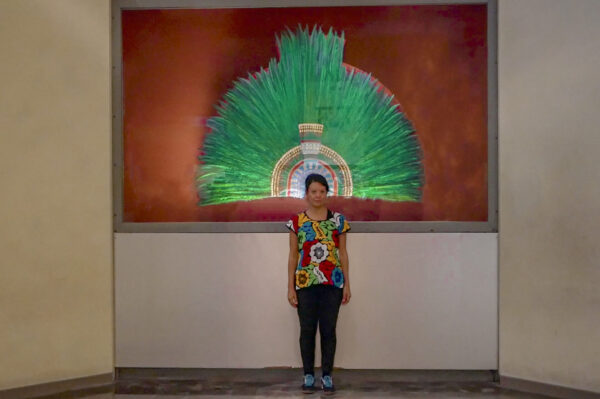
Screenshot
This morning, I took a short walk to the National Museum of Anthropology in Mexico City. It is Sunday, a free day for visitors who are Mexican citizens, and I am here to see the replica of El Penacho de Moctezuma.
After noticing people waiting in line to take their picture with the headdress, I joined them.
The original headdress may have belonged to Moctezuma II, the ninth Aztec ruler from 1502 to 1520. It consists of five hundred tail plumes from quetzals, a bird native to southern Mexico and Guatemala. It could have been a gift or among the items taken from Moctezuma II by the Spanish conquistador Hernán Cortés. In the late nineteenth century, the headdress came into the possession of the Austrian geologist and explorer Ferdinand von Hochstetter. Today, the headdress is displayed at the Weltmuseum Wien, where it has become a significant cultural artifact. Its repatriation remains a contentious issue, with ongoing disputes between the governments of Austria and Mexico.
The label next to it does not mention anything about the original.

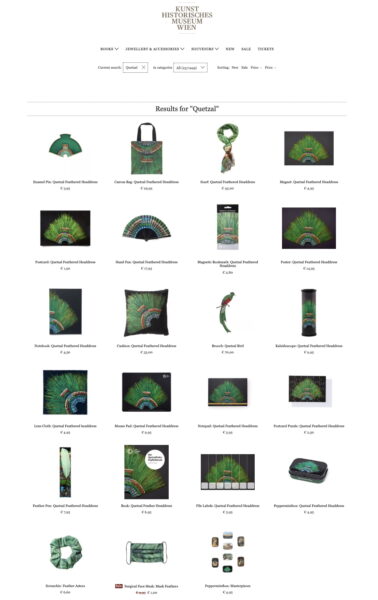
The Weltmuseum web shop sells a postcard featuring an image of the headdress, among other items.
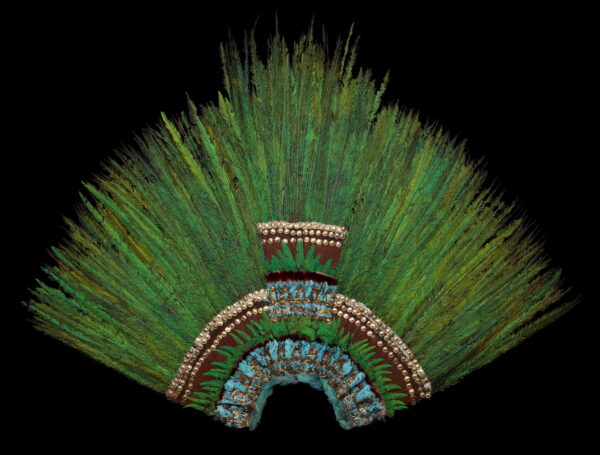
Penacho, Weltmuseum Wien, postcard.
Size: 10.5 x 14.7 cm
€1.50.
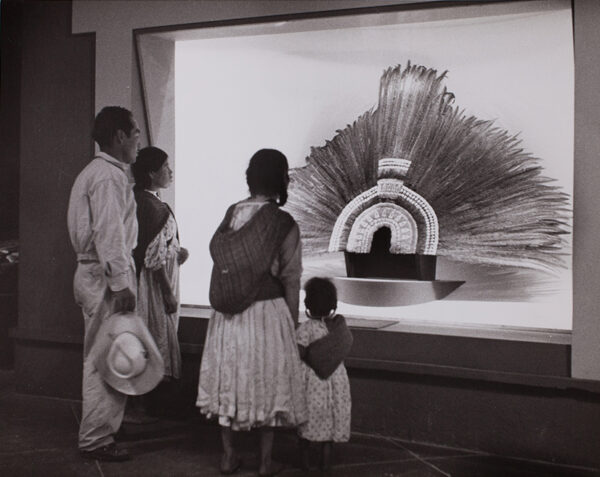
Archivo Histórico del MNA, 1960. Photo: Ricardo Salazar.
This photograph from 1960 may have been staged, as there is limited information about it. Did they realize they were looking at a replica? Did it matter? In this image, there is a reverence for the object seldom seen among those waiting in line before the replica today. Why has this changed? Is it our comfort with and access to the camera, or something else? The Penacho is no longer an object to observe, but one to possess and claim.
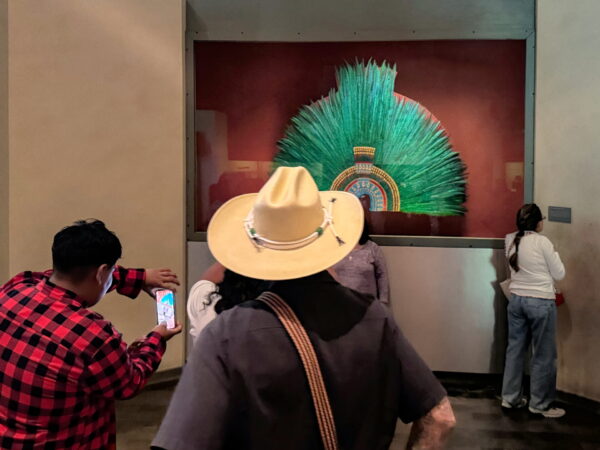
Before leaving, I take a picture of the crowd around the object.
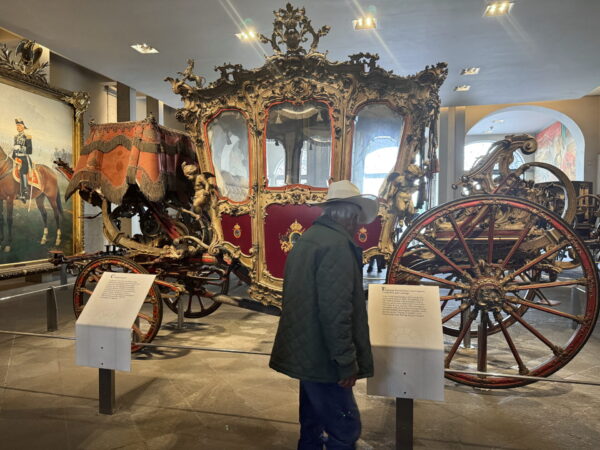
Later, I visited Chapultepec Castle to look for Emperor Maximilian and Empress Carlota’s Gala Carriage. Maximilian, the second son of Archduke Franz Karl of Austria, served as Emperor of Mexico from 1864 until his execution in 1867. He and his wife, Empress Carlota, lived at Chapultepec Castle.

This vintage postcard features an aerial view of Chapultepec Castle. Sitting high amid the greenery—its elevation rivaled only by the nearby glass and metal skyscrapers—it remains a strange sight to behold. An image suspended in time.
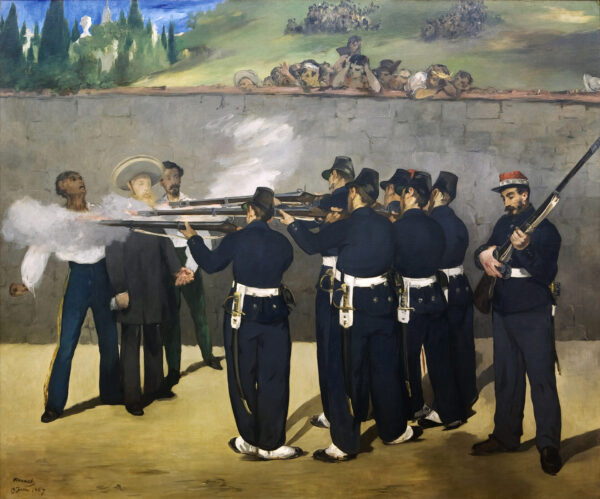
Image: Wikimedia Commons
Édouard Manet painted The Execution of Maximilian in 1868, a year after the actual event. Curiously, he signed it with the date of the execution, 1867, as if he had been present at that very moment. There is a shadow in the lower right corner. Is it the painter’s or the viewer’s?
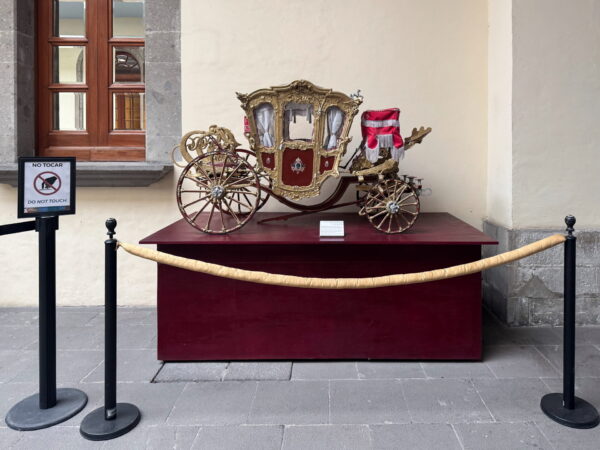
To my surprise, a miniature replica of the carriage sits just around the corner. In 2011, the government of then-president Felipe Calderón proposed lending agreement the Penacho in exchange for the carriage. The Viennese government declined the offer. Was the miniature created in case the Viennese had accepted, leaving us with a copy of the carriage?
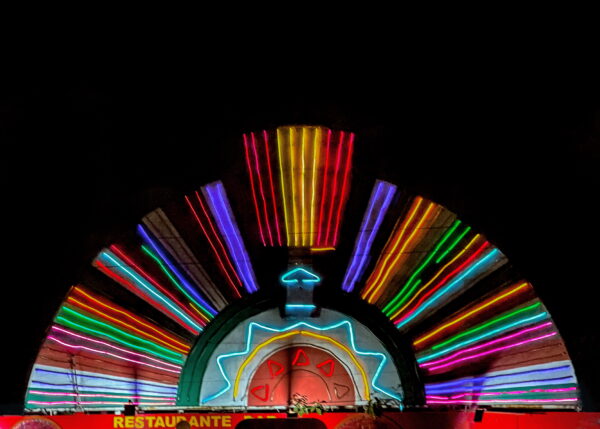
That night, I had dinner at El Penacho de Moctezuma, a restaurant in Mexico City. Outside, a large neon image of the headdress greets visitors.
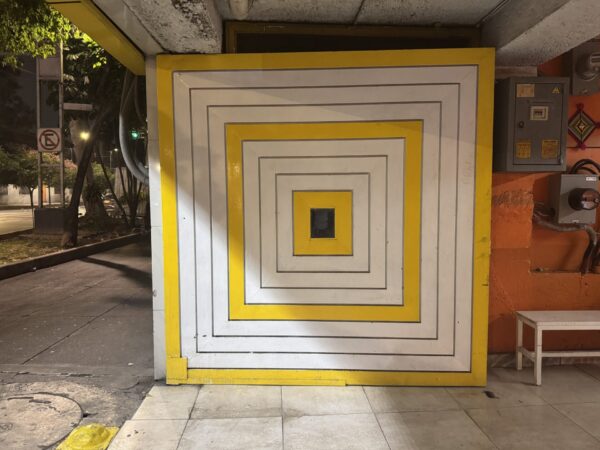
A Frank Stella–like painted door welcomes me as I search for the entrance to the restaurant. Beyond it, a corridor is adorned with several small Ojos de Dios, or Tzicuri, as the Wixárika, a Native people of Mexico, call them. One cannot help but notice the similarity between the modernist, geometric, iconic painting and these more spiritual, humble objects, whose purpose is to aid in seeing beyond our present realm.
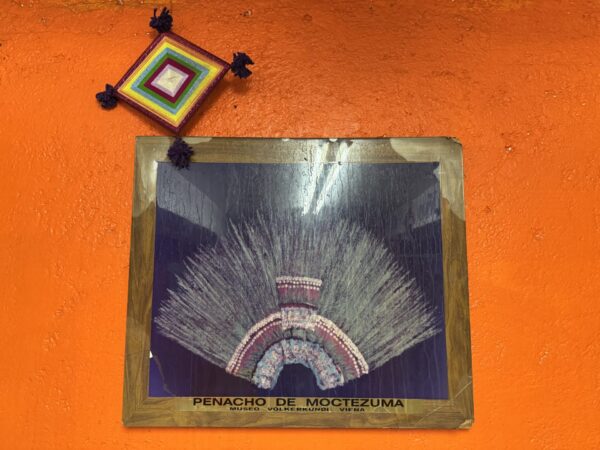
On the wall, one of these Tzicuri hangs above a frame containing a postcard image of the original headdress and an inscription noting its current location: the Weltmuseum in Vienna. The lacquered surface shows cracks, as if yearning to release its object.
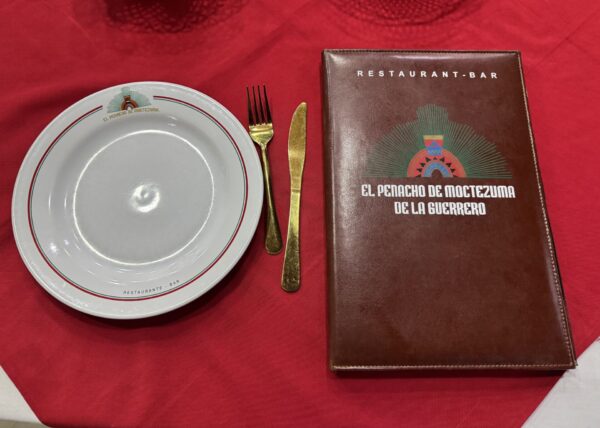
Everything around here bears its image. The table is set, and all around me people devour their meals joyfully.
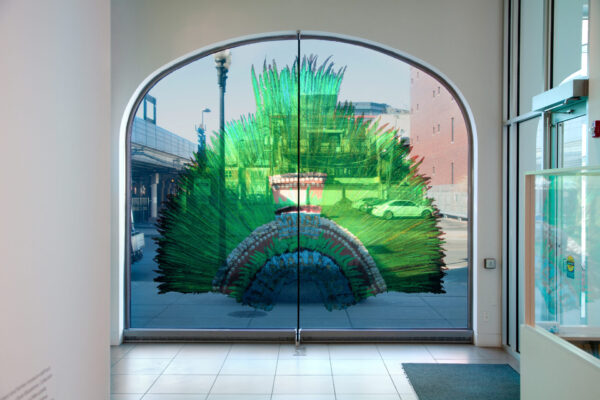
Quetzalli, 2021
Vinyl, 140 x 167 in.
Curated by Ionit Behar
DePaul Art Museum, Chicago (inside window view)
A composite image of the headdress combines elements from the original at the Weltmuseum Wien and the reproduction at the National Museum of Anthropology in Mexico City. The upper section, made primarily of quetzal feathers, is taken from the reproduction, while the lower crown portion is from the original.
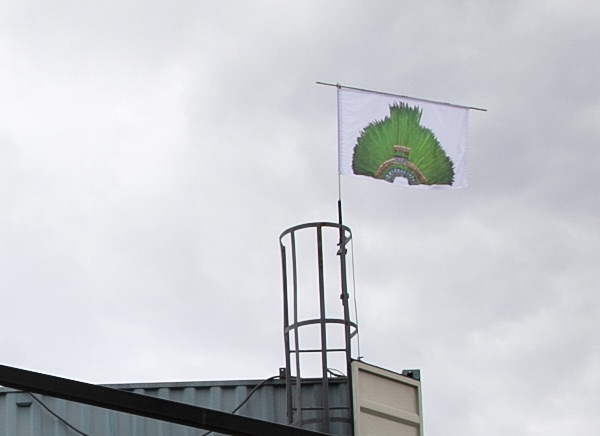
Quetzalli Flag, 2021
Fabric, 39 x 78 in.
Der Kunstsalon in FLUCC, Vienna
Flag of the Penacho composite image waving in Vienna, as part of the exhibition Properties of a Presence, curated by Khadija von Zinnenburg Carroll
Claudia Peña Salinas lives and works between Mexico City and New York. Peña Salinas studied at the Art Institute of Chicago and received an MFA from Hunter College, New York. Her work includes sculptures, installations, paintings, videos, publications, and photographs and has been displayed at Casa Gilardi, Mexico City (2025), Museum of Fine Arts St. Petersburg, Florida (2024), Es Baluard Museu d’Art Modern, Mallorca, SP, (2023), Contemporary Art Center, Cincinnati (2022), The High Line, New York (2021), DePaul Art Museum, Chicago (2021), Hessel Museum of Art, Bard College, New York (2021), Centre Pompidou, Paris, FR, (2019), the Arizona State University Art Museum, Arizona, (2019), the Whitney Museum of American Art (2018), Museo de Arte Carrillo Gil (2015), Queens Museum of Art (2012), Art Museum of Puerto Rico (2006), and Museo del Barrio, New York (2005).