

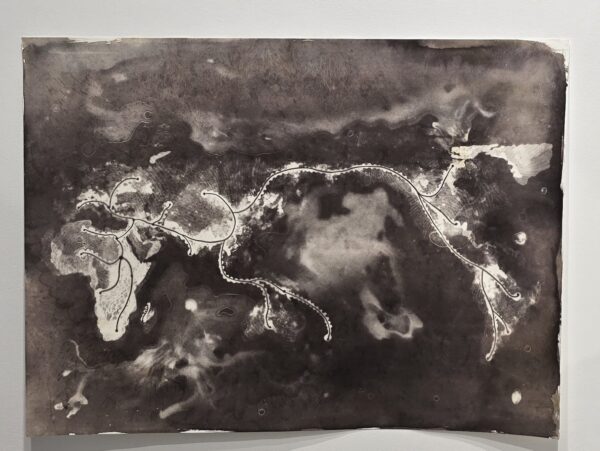
Fig. 3. Sènami Donoumassou, Couleur de l’eau, couleur de l’âme, couleur du sang, 2024. Close-up of the map in the installation. Photo: Adéwolé Faladé.
On a hot and humid afternoon in July 2023, I participated in “Arts/Archives/Performances” in Porto-Novo, Benin. During the workshop, a group of African artists and African and European social science scholars and museum professionals discussed artistic research in archives created during colonial times.1 We focused on the corpus of still and moving images collected by Father Francis Aupiais, a French missionary who roamed several regions of Dahomey (the French colonial name for Benin) and documented its Catholic and cultural lives in 1930 during a journey financed by the banker Albert Kahn. A young Beninese woman sitting next to me seemed deeply engaged in the discussion about art’s potential to offer a nondiscriminatory gaze on those archives, creating space for the silenced voices of the colonized people to finally be heard. I introduced myself and learned that she was Sènami Donoumassou, a visual artist. Born and based in Benin, in her work she experiments with the technical and poetic potential of light through photograms, protean installations, and drawing, inviting us to reflect on notions of identity, otherness, archives, and memory. For the artist, every individual is an archival body containing multiple identities. As she puts it: “We are made of animal DNA, plant DNA and minerals. We are cells, but above all we are traces and memories. As beings made up of several elements, we represent living archival bits that are interconnected.”2
In 2022, when I discovered Donoumassou at Revelation! Contemporary Art from Bénin—the traveling exhibition of Beninese contemporary art that coincided with the repatriation of twenty-six artifacts from France to Benin—I immediately became interested in her work. Using visual tools, she initiates dialogues between the present and the past, between the collective and the individual. In September 2024, shortly before the opening of Revelation! at the Conciergerie in Paris and her solo exhibition Tàn xó [Memory in Prose] at Fondation H, I met with her to talk about her work in the two shows and the meaning of restitution.3
Adéwolé Faladé
As I stepped into Fondation H, I was almost immediately swallowed by Arkhéenia, the fictional space you created for this exhibition, which highlights our otherness and foreignness while at the same time creating a common thread between us. Your usage of archival films also struck me. You edited archival silent films from the Musée Albert Kahn in Boulogne-Billancourt, conceiving a short piece featuring people around the world practicing different religions yet using gestures that look incredibly so much alike. It’s a way for you to state that we might believe we are different but truly we are not. This set the tone for what your artwork was examining—the collective versus the individual, our so-called differences, the creation and usage of archives. How did your project Memory in Prose and the name Arkhéenia come to be?
Sènami Donoumassou
For some time, I have been wondering about our relation to the notions of territoriality and citizenship. What does it mean today to be French, or Beninese? Can we say that someone who wasn’t born in Benin but spent twenty years there and acquired the citizenship is less Beninese than someone born in the country? What is religion, skin color, or territoriality when it comes to defining a person’s identity? Because these are the very same elements that are used to reject the other. But in the end, we are all human, we all share the same origin, we all share the same collective memory. We come from nature, we are made of natural elements—minerals, bacteria, cells. The aspects that bring us together also fuel our rejection of the other. We’re living in a more and more radicalized world.
All that was going through my mind when I came across Maya Angelou’s “On the Pulse of the Morning,” written in 1993 for Bill Clinton’s presidential inauguration. In her poem, Angelou addresses memory, sense of belonging, identity. Using allegories of natural elements, she questions our connection with shared memories, the diversity of humankind, the territories they occupy, and the relations among various populations. The poem is set in a fictive world.
That’s what inspired me to begin the exhibition with Arkhéenia, an imaginary territory. The word stems from Archéen (Archeen). Looking up the word archive, I was led to Archean, the geological era when the only form of life on earth was cells, bacteria. The link between archives and cells agglomerating to form life seduced me! In a way, archive also refers to the origin of life, the inception of something. I used that made-up name to say: “Welcome to the source. Welcome to our common origin.”
AF
Tell me more about the pieces exhibited. How did you establish a connection between them?
SD
On the upper floor, the visitor walks into the exhibition room, crossing the border of the fictional territory, Arkhéenia, into an area that isn’t affected by the passage of time or the changes occurring in the world. The installation Couleur de l’eau, couleur de l’âme, couleur du sang (Color of water, colour of the soul, color of blood), composed of mirrors, photos, candles, dried leaves, and more, is in direct dialogue with the short film Connected? These two pieces allow me to interrogate our collective history and how our practices, beliefs, religions, and viewpoints have led us to wars, to rejecting others, and even to committing crimes and genocides. The installation also delves into the trauma left in both the victims’ and perpetrators’ personal histories—the traces it leaves in blood, in family heritage, and in the memory of humanity. And how do we, today, while still employing the same practices, the same religious and traditional beliefs, attempt to purify the spilled blood? There have been multiple massacres in the history of humanity—massacres triggered by religion, ethnic differences, political viewpoints, and so on—and they are still occurring today. The other aspect of the installation is the soundtrack. The repeated heartbeat symbolizes the passage of time, which never stops. Regardless of what we do, whether we live or die, time keeps passing—time will always exist.
On the lower floor, the visitor’s bare feet tread on sand in a dimly lit room. On one of the walls of the room, a question, or rather an invitation to ponder, engages and challenges the visitor: “Que laisseras-tu de toi?” (What trace will you leave?) A short film of different plays of light is screened on the next wall. The viewer follows the feet of the unknown main character, who is apparently walking aimlessly, a movement punctuated by several voices and subtitles expressing various identity traits and origins. Every single one of us may think that we are distinct, but ultimately we are composed of bits and pieces from culture, history, and nature. In the end, we all belong to a collective memory, the same shared collective memory. In one corner of the room, there is a space dedicated to introspection and reflecting, sitting or lying on a mat and writing one’s tentative answers in a notebook. What traces or memories do we wish to leave? What form will they take?
AF
Speaking of traces and memory, the link to the past, to tangible and intangible memory, I’d like to talk about the artifacts that have been restituted. I’d like to go beyond the materiality that has been returned. We all know that the twenty-six artifacts that France repatriated in November 2021 to its former colony, the Republic of Benin, held different functions and were of different natures. I’d like to know how you—someone who works on memory, archives, traces, on what can’t be seen—look at the objects that have come back? How do you understand them?
SD
The fact they have been restituted, the fact that Benin is the first African country to receive artifacts, shows that African countries are entering a new phase, sociologically and politically speaking. I think that, symbolically, it is high time for the power dynamic to shift. We must not forget that the works that have come back stayed in the West for a long time. They have had other lives, and now they will have a third one, so to speak. It’s a bit similar to us, actually. We had a life before colonization, a life during colonization, and a life after colonization. After the official end of colonization, we became hybrid individuals, a blending of knowledge and culture from these eras. Objects are the same. I see them as objects that were loaded with meaning before they left, and upon their return even more so. They were here in Paris for a long time—a lot happened during that period. They carry a double meaning. Then, the fact that, once in Benin, they are going to museums is symbolically powerful. This will enable us to pass on to young people the practices of our ancestors.
As of today, we have been acquainted with only a few aspects of our own past. Consequently, the return of artifacts may allow us to gaze back. Going to the museum, seeing these objects, and drawing young people’s attention to them will help them understand that they come from a people or families who had a strong culture, a strong spirituality, and that these elements were transcribed through the objects. Objects must play a role in transmitting the memory of yesterday, but also to some extent the memory of today.
For example, you discovered them for the first time in the Musée du quai Branly, and you were told that they came from Benin and were taken away during the war. Now young people are going to see them in Benin and will be told their story. The youth will learn about the kings they represent, the looting by the French, their long stay in Europe, and finally their return. This adds another layer to their history, to their biography.
AF
One of the outcomes of the restitution was the exhibition Revelation! Contemporary Art from Benin. Artworks by forty-two contemporary Beninese artists are on display. The different pieces exhibited enhance the close link between art and the sacred dimension of Beninese cultural life. After stops in Morocco and Martinique, the traveling exhibition is now about to sojourn in Paris at the museum the Conciergerie. I noticed, in particular, the diversity of tools and media—painting, installation, video, sculpture, and photos, like your pieces. What link do you establish between your exhibited works in this specific exhibition and the objects that were returned?
SD
There are the soot drawings Ombre 1 (Shadow 1) and Ombre 2 (Shadow 2, both 2021), and photograms that are a way of shedding light on our past and on how to better know ourselves. I see the soot drawings as a way to focus on what we don’t want to see. For me, what is not seen matters as much as what is seen. During our upbringing, we inherit our ancestors’ secrets, evil alliances, or wrong deeds. All that transpires through soot. Soot is considered something dirty—it’s something you don’t want to touch or go out covered in. It’s an opportunity for me to ask: What are we trying to hide from ourselves? Where do our fears lie? What are we rejecting? What do our shadows stand for?
It’s only by searching in the shadow that we can find the light. You can’t run away from your shadow and find the light—that’s impossible. You have to accept it. The more you try to run away from your shadow, the more likely you are to develop a mental disorder. When I talk about shadow, I’m referring to trauma. Everything we repress is what I call the shadow, and it’s also what Carl Jung calls the shadow. Everything that is repressed, consciously or unconsciously, born from personal experience or from the experiences of a person who lived before us and passed down through the bloodline, is what I dig up.
Adéwolé Faladé is a cultural heritage activist with a passion for multiculturalism. For more than a decade, she has collected, preserved, and promoted the cultural heritage and traditions of the Republic of Benin through Mewihonto, the association she has directed since 2016. Within Mewihonto, she has had multiple roles, including field investigator, journalist, project manager, and coeditor. Faladé earned a Master of Arts in British, American, and postcolonial studies from the Université La Sorbonne in Paris (2008) and a Master of Arts in French literature from the University of Illinois Chicago (2009). Upon her return to Cotonou, Benin, she worked as a French-to-English translator and interpreter as well as an English teacher at private and international institutions. Simultaneously, she engaged with the local art scene, working with musicians, actors, film and theater directors, and event planners in Benin and other African countries. Faladé is currently a doctoral candidate in comparative history at the Central European University (CEU) in Vienna. Her interests revolve around the restitution of Beninese artifacts from France and the new ties fostered through their return. She is also a researcher for the Repatriates project funded by the European Research Council (ERC).
Sènami Donoumassou was born in 1991 in Benin. She currently lives and works as a visual artist in Cotonou. Donoumassou explores notions of identity, heritage, and history through her practice. In her creations—which oscillate between photograms, protean installations, video works, and drawings—she experiments with the technical and poetic potential of light. She has developed a body of work around oral traditions, body memory, and various African philosophies. She has participated in several international residency programs, including Villa N’dar, Saint-Louis, Senegal (2024); Villa Ruffieux, Sierre, Switzerland (2024); and Trame at the Cité Internationale des Arts, Paris (2023). Her work has been featured in exhibitions including Unraveling the (Under-)Development Complex at SAVVY Contemporary, Berlin (2022); Rencontres de Bamako (2022); and Xógbé and Amazones, both at Le Centre, Abomey-Calavi, Benin (2022 and 2017, respectively). In 2024, she took part in the Dakar Biennale and presented a solo exhibition at Fondation H in Paris. She received the inaugural James Barnor Award in 2022 and a special mention from the jury of the Photography Award at the Musée du quai Branly – Jacques Chirac in 2024.