

Photo credit : Adéwolé Faladé.
Beyond the several artistic, political, and cultural forms of reappropriation, more original and contemporary ways of reappropriating are also emerging, and are, as a result, more accessible to a group of the population in Benin’s largest city. The repossessing of elements of Danhomey culture and identity occurs in unexpected ways within the urban landscape of Cotonou. It finds its way into the city’s warm, rhythm-filled nights. Since France’s repatriation of the twenty-six royal treasures of Abomey in November 2021, numerous cultural, social, and spiritual references have permeated daily life and the urban space. Consequently, an entire market has emerged, along with a commercial reappropriation and, above all, greater visibility for the various facets of Danhomey’s identity and heritage. This movement is also part of a policy of institutional promotion of vodun, as evidenced by the Vodun Days events held in Ouidah since January 2024.
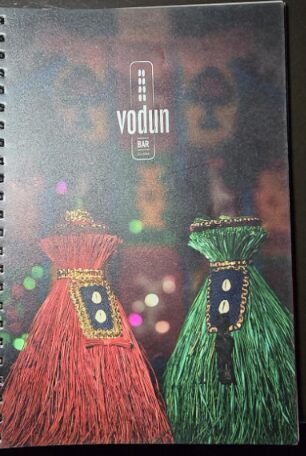
A venue called “Vodun Bar” has opened in the heart of Cotonou and is bustling with nightlife every weekend. It offers its guests a multisensory experience. The decor, the names of the cocktails, and the photographs illustrating them: a conscious effort has been made to ensure that very concrete and easily identifiable details immediately evoke the best-known aspects of Danhomey as well as Yoruba spirituality.
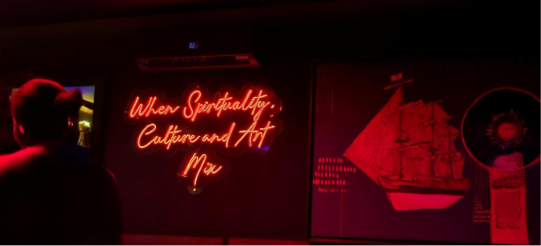
Photo credit : Adéwolé Faladé.
The tone is set by a red neon sign with the English phrase: “When Spirituality, Culture, and Art Mix.” This phrase sums up the venue’s mission: to bring together, within a single recreational space, the realms of the sacred, cultural heritage, and artistic creation. The walls, bathed in red light, feature objects and images displayed in illuminated niches: a mask with glowing eyes, a carved seat clearly inspired by the royal thrones of Danhomey, a small conical figure made of red fibers evoking the Zangbéto guardians of the night, a painting depicting a ship, and a full-length portrait. This exhibition design openly draws on the conventions of museum displays: the object is isolated, highlighted, and presented for viewing. One might hypothesize that the bar functions, in its own way, as a venue for showcasing cultural heritage to an audience that does not necessarily visit museums.
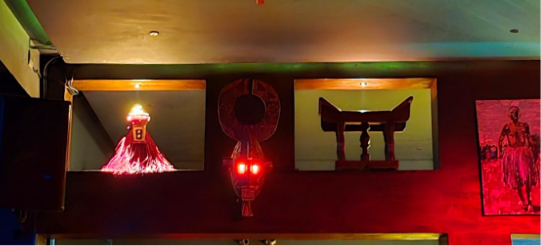
Photo credit : Adéwolé Faladé.
The menu deepens the immersive experience. It is bilingual, both in French and English, suggesting that the clientele is intended to extend beyond the local audience alone to include expatriates, passing visitors, and members of the diaspora. The “Signature Cocktails by Vodun Bar” section is at its heart. Each cocktail is named after a deity from the Vodun pantheon, accompanied by a carefully staged photograph and a short description that introduces the deity and explains the drink’s composition. Hèviosso, “god of the sky, lightning, and justice,” combines gin, sodabi, and chili pepper. It is described as “an explosion of spicy and smoky flavors, intense and bold, just like his power.” The accompanying photograph shows him enveloped in smoke and sparks. Sakpata, “the deity of the earth and healing,” is served in a glass shaped like a carved face, set on a bed of earth where one can make out the outlines of the divination oracle’s signs traced by the finger of the “bokonon” (the person who interprets the signs of the divination oracle, the Fâ). Dan, the “deity of wealth and good fortune,” is depicted in bright blue against a background of sand arranged in concentric circles. Tohossou, described as a “protective spirit,” ensures “stability and harmony.” Finally, the VDB, “the soul of the Vodun Bar,” is photographed alongside a costume embroidered with sequins and cowrie shells, reminiscent of the attire of the Egungun spirits from Yoruba mythology.
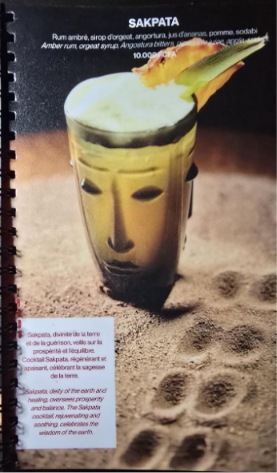
Photo credit : Adéwolé Faladé.
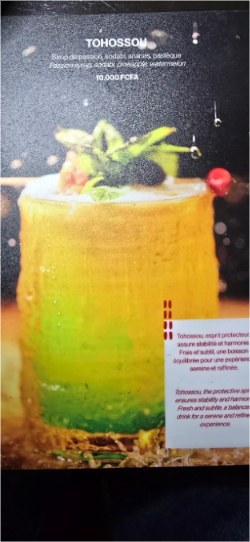
Photo credit : Adéwolé Faladé.
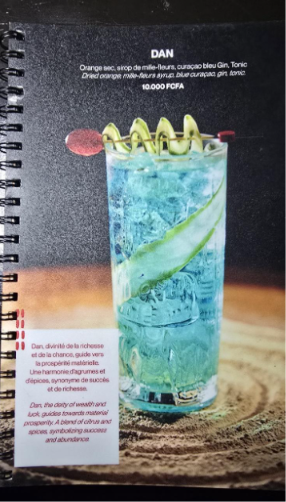
Photo credit : Adéwolé Faladé.
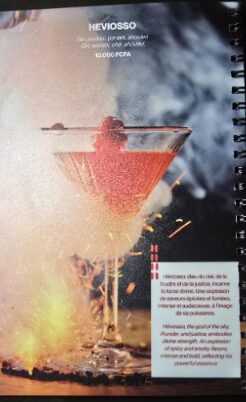
Photo credit : Adéwolé Faladé.
One ingredient deserves special attention: sodabi. This palm brandy, commonly used in libations, is a key ingredient in four of the five signature cocktails (Tohossou, Sakpata, Hèviosso, and VDB). It is combined with gin, rum, curaçao, or agave syrup: the staples of international mixology. This move is telling: a local product, steeped in ritual significance and long associated with popular consumption, is redefined as a prestigious ingredient. The glass becomes the vehicle for a dual purpose: both celebrating Beninese craftsmanship and translating that craftsmanship into the global language of nightlife.
This concept, however, calls on several clarifications. The first concerns accessibility. Each signature cocktail is priced at 10,000 FCFA (approximately 15 euros), a price point that places the venue within the realm of an affluent urban social scene. The accessibility in question is therefore less economic than symbolic: Danhomey’s cultural heritage is accessible here without any prior introduction or museum-like barriers, in the familiar setting of a party. It appeals to a specific part of the population—young, urban, and affluent—rather than to all residents of Cotonou.
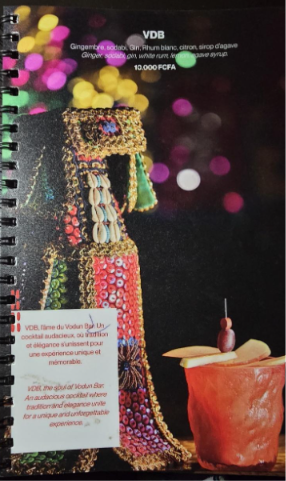
Photo credit : Adéwolé Faladé.
The second nuance relates to simplification. The map’s text reduces each vodun to a single, easily identifiable function: wealth for Dan, healing for Sakpata, justice for Hèviosso. It overlooks the complexity of the cults, their taboos, and their ties to lineage and territory. The case of Tohossou speaks volumes: while the Tohossou are closely associated with the royal dynasty of Abomey, the map reduces them to the generic figure of a “protective spirit.” The political and royal dimension, which is, after all, at the heart of Dahomey’s identity, fades into the background behind a spirituality focused on well-being.
The phenomenon is thus subject to differing interpretations. For some, it reflects a commodification of the sacred, which detaches deities from their ritual contexts and transforms them into brands. For others, it contributes to the normalization of vodun in the public sphere, a sphere long marked by stigmatization inherited from missionary and colonial discourses. It attests to a confident sense of cultural pride. These two interpretations are not necessarily mutually exclusive.
The “Vodun Bar” is, ultimately, a valuable indicator of the post-restitution period. It shows that Danhomey’s cultural heritage no longer circulates solely among museums, palaces, and institutions, but is becoming a resource harnessed by private actors in spaces of consumption and social interaction. This shift directly challenges the way in which sacred objects, images, and names are being recontextualized in the city today.
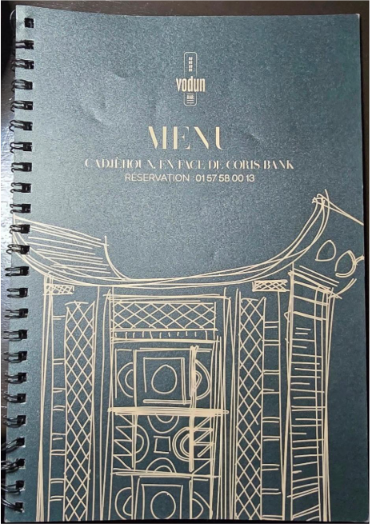
Photo credit : Adéwolé Faladé.