

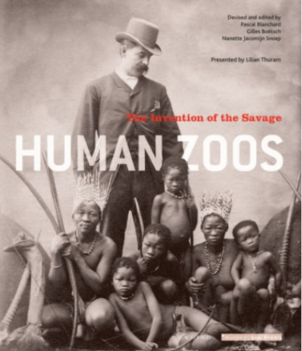
Cover of Human Zoos: The Invention of the Savage, 2011
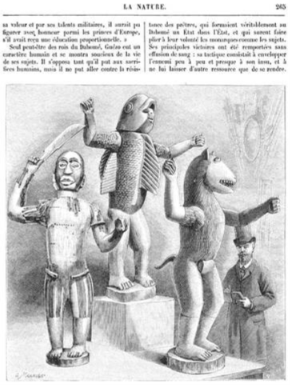
Drawing of the three bochio at the Musée d’Ethnographie du Trocadéro,1894
Two images about a decade apart, stage the same scene: a Western man dressed in a dark suit and a top hat, stands at a distance from what he observes. In the first one, a photograph taken at the Jardin d’Acclimatation in Paris in the 1880s and now well known as the cover of the catalogue Human Zoos: The Invention of the Savage, he stands behind a group of Africans, adults and children, posing in a studio setting. In the second one, an engraving published on 24th March 1894 in the French popular science magazine La Nature to illustrate an article by Maurice Delafosse, shows him standing behind three royal statues of kings from the Kingdom of Danhomey exhibited at the Musée d’Ethnographie du Trocadéro. The onlooker changes, just like the settings and what is observed as well: living people in the first case, objects in the second.
What do these images reveal about how the French perceived Africans at the end of the nineteenth century? These two images share a common structure: the Western viewer maintains a distance. The gazes never meet. The Other is placed in the foreground, facing the viewer. Furthermore, within this same common structure, the meaning of the distance evolves. In the photograph, distance is synonymous of hierarchy. It expresses ownership over bodies. In the engraving, distance becomes a tool to articulate the scientific and anthropological analysis of objects.
In the photograph, the man looks down on the group. The man stands very close to the group, almost in their midst, and yet above them. His demeanor and gaze convey a sense of control: his proximity is intrusive; his posture is that of an owner showcasing his property. Indeed, the adults are crouching, which reinforces the visual impression of inferiority: with the exception of one child, the European is the only figure standing. The vertical axis of the image transposes a racial hierarchy into a spatial one. Additionally, an ostrich is also depicted at the same level as the group, as if to suggest that these men, women, and children stood on the same level as the animal. This juxtaposition is not coincidental. The Hagenbeck Company traded wild animals and staged human beings through the same networks, while the Jardin d’Acclimatation exhibited them in the same spaces. Human beings were thus reduced to the status of specimens, and specimens to that of merchandise.
In the engraving, Delafosse looks at his notebook or the statues, never at their faces. Conversely, the “Others” are placed in the foreground and face the viewers directly. The women and children stare directly into the camera, and the statues stand before the reader. Thus, the observer who dominates through his gaze, is never looked at in return by those he contemplates. Their gaze is directed toward another audience: the Western public, the reader of the magazine or photo album, who is in turn invited to examine them. In the 1894 engraving, non-European culture occupies the foreground: the statues face the viewers, take up most of the image, and make the man standing behind them appear tiny. The Frenchman is relegated to the background. The distance separating him from the statues is no longer a hierarchy of bodies, but a distance of observation: that of a scholar who describes, compares, and classifies. The image echoes the scientific ambition of La Nature and Delafosse’s article, which described the statues in detail. The objects are no longer presented as curiosities, but as historical records, specifically, those of the kings of Danhomey.
However, this scientific distance should not be idealized. In that same article, Delafosse noted that the statues had suffered “the ravages of time and the mutilations inflicted by the African soldiers enlisted in our expeditionary column”: king Guezo’s statue’s metal feathers had been torn off, king Glele’s statu’s had lost an arm and part of his snout, and king Behanzin’s statue’s had lost his lower jaw. Besides, the publication date is eloquent. On January 15, 1894, king Behanzin surrendered to the French. Two months later, the Parisian public could view his effigy in a museum in the capital. In the engraving, king Behanzin’s statue towers over the other two. The defeated king still stands, but inside a display case. The distance here is also that of the victor contemplating his trophies.
To conclude, the photography and the engraving reveal both change and continuity. Change, because the relationship between the Westerner and what he observes shifts in meaning: we move from possession to analysis, from the domination of bodies to the classification of objects. Continuity, because in both images, the gazes never meet, and the Other, placed in the foreground, is presented to an audience that never has to meet his gaze. Furthermore, the photograph belongs to two worlds at once. It was taken by a researcher whose goal was to catalog human “types,” and it depicts a showman whose goal was to sell a spectacle. Science and commerce, anthropology and entertainment, share the same frame. The gaze of possession and the gaze of classification are not yet separated.
References:
Beaujean-Baltzer, “Du trophée à l’œuvre.”
“Carl Hagenbeck,” Wikipedia; Pascal Blanchard et al., eds., Zoos humains et exhibitions coloniales: 150 ans d’inventions de l’Autre. La Découverte, 2011.
Delafosse, Maurice. “Statues des rois du Dahomé au Musée ethnographique du Trocadéro.” La Nature, no. 1086, March 24, 1894, 263–65. CNUM. http://cnum.cnam.fr/CGI/redira.cgi?4KY28.42 .
Maurice Delafosse, “Statues des rois du Dahomé au Musée ethnographique du Trocadéro,” La Nature, no. 1086, March 24, 1894, 263–65, CNUM, http://cnum.cnam.fr/CGI/redira.cgi?4KY28.42 ; engraving on p. 265.
Pascal Blanchard, Gilles Boëtsch, and Nanette Jacomijn Snoep, eds., Human Zoos: The Invention of the Savage (Actes Sud / Musée du quai Branly, 2011), cover.