

Among the artistic works resulting from the November 2021 restitution, one key theme deserves special attention: the spotlight placed on historical female figures from the Kingdom of Danhomey. This shift is driven by several simultaneous trends, such as the rise of African and Afro-descendant feminism in contemporary cultural debates, the increased international visibility of the Agoodjié (Danhomeyan female soldiers) following big-budgeted film productions, and, more fundamentally, the need to fill a major historiographical gap: the systematic erasure of women from the dominant narratives of Danhomey history.

Adéwolé Faladé. Danhomey universe, Danhomeyan bas-reliefs. Scene from the 2D animated film Kancica.
The 2D animated film entitled Kancica (meaning “the rope that binds” in Fon language), released in January 2026, represents an interesting contribution. It tells the story of Nan Agontimè, the queen mother of King Guézo (1818-1858) and one of the most important female figures in Danhomeyan history. Her fate illustrates with particular clarity the contradictions of the nineteenth-century royal regime. Nan Agontimè was one of King Agonglo’s wife, Guézo’s father. He reigned from 1789 to 1797. She played a decisive role in Guézo’s accession to the throne in 1818, when he overthrew King Adandozan, his brother. She was, however, sold as a slave by Adandozan himself before his downfall and deported to the Americas. There, according to several Brazilian sources, she became a major figure of Brazilian voodoo. Her story is thus a living metaphor of Danhomey’s contradictions: a kingdom that engaged in the slave trade while simultaneously producing figures of resistance and female sovereignty who would fuel the imaginations of the African diaspora for generations to come.

Adéwolé Faladé. Kneeling down, Nan Agontimè is being arrested at the Danhomeyan royal court. Scene from the 2D animated film Kancica.
Kancica narrates the story of Dotou, a young female cartographer sent out to find Nan Angontimè in Brazil and bring her back to the kingdom of Danhomey. She sets on sailing across the Atlantic Ocean, helped by Danhomeyan vodun gods. When she disembarks in Sãn Luís do Maranhão, Nan Angontimè has already passed away but her legacy lives on through the worship of Zomadonou, a Danhomeyan cult she set up there. This cult she established in a convent called Casa das Minas, is a matrimoine as it is only passed on from one female high “priest” to another. Kancica chooses to tell the story in 2D, using a graphic style that deliberately draws on the aesthetics of contemporary African comics while incorporating visual references to the embroidery and decorative motifs of historic Danhomey, the very same patterns found on the palace doors carved by Sossa Dédé. They are part of the 26 returned objects.

Adéwolé Faladé. Dotou, the female cartographer, sails across the Atlantic Ocean toward Brazil. Scene from the 2D animated film Kancica.

Adéwolé Faladé. Dotou, the female cartographer, consults a map as she sails across the Atlantic Ocean toward Brazil. Scene from the 2D animated film Kancica.
This formal choice places the narrative within a continuum of contemporary forms of expression on the continent, rather than confining it to a static historical reconstruction. The title “The Rope That Binds” refers both to the slave’s rope (the violence of deportation, the broken bond) and to the rope that maintains the community united across space and time (the transatlantic bond, the shared memory). This dual meaning serves as the central theme of the work: the story of Nan Agontimè, which is not only a story of suffering but also one of cultural continuity, steadfast resistance, and the reconstruction of identity through the diaspora. In this sense, Kancica fully aligns with the logic of biographical reactivation via artistic medium. It also demonstrates that the goal is not to simply restore a past but to (re)connect it to the present through a creative act that transforms the diaspora not into a place of exile but into a space of transmission.
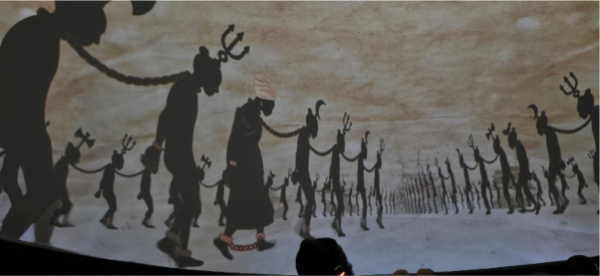
Adéwolé Faladé. Nan Agontimè enslaved, chained and sold among numerous enslaved Africans. Scene from the 2D animated film Kancica.
The resignification of shared memory, of binding ties, are enhanced social and cultural characteristics originating from the Fon population that survived in Sãn Luís do Maranhão. It draws on social, cultural and spiritual similarities between the kingdom of Danhomey and the practices in the Casa das Minas. Namely, nature is deeply impregnated within Fon cultural and spiritual lives, particularly trees. After her passing, Nan Agontimè is reincarnated into a magnificent tree with a dense foliage. It symbolizes longevity, shelter, haven but also a place where knowledge and memory are to be transmitted.
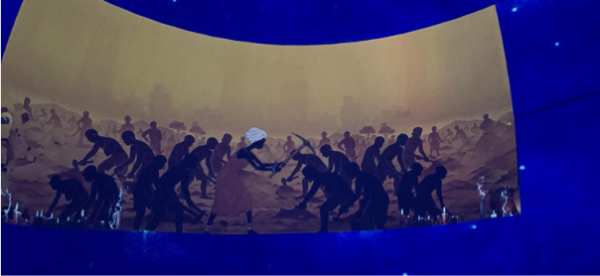
Adéwolé Faladé. Nan Agontimè enslaved, working in plantations in Brazil. Scene from the 2D animated film Kancica.
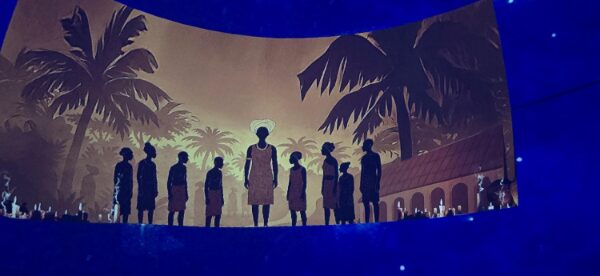
Adéwolé Faladé. Once a free woman, Nan Agontimè founded the Danhomeyan cult of Zomadonou in the Casa das Minas which attracted a growing number of worshipers. Scene from the 2D animated film Kancica.
Furthermore, in the Fon culture, imposing trees receive ceremonies and donations for the ancestors. The living communicates and honors the spirits those of the afterlife through these types of trees. Nature is protected because it is declared sacred. A set of rules and bans punctuate the lives of the people linked to the natural elements. Another social and cultural element, partly derived from the Fon Kingdom is also present in many scenes in Kancica: the color indigo blue. This recurring color accompanies the viewer throughout the animated film, whether during scenes depicting the moment Dotou is entrusted with her mission, during her crossing of the Atlantic Ocean, or when Nan Agontimè, after living as a slave, breathes new life into her existence by establishing the Zomadonou cult, or finally when the tree that reincarnates the deceased queen grows and unfurls its lush foliage. This color, with its captivating hues, embodies feminism, its strength, and its resilience. Indeed, according to visual artist Moufouli Bello, known worldwide for her use of indigo blue in her paintings, in which she depicts only women, indigo symbolizes, among other things, identity, strength, peace, purity, and modern femininity: “Characterized by her emblematic colour palette, blue particularly reflects myriad qualities such as strength, density, healing, lively emotion, purity, and peace. Blue is frequently present in Yoruba culture and used by Bello to express not only identity but also to create new realities conveying alternative female representations, celebrating the fullness of black, modern femininity.”
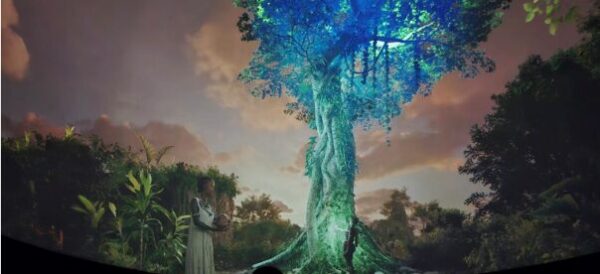
Adéwolé Faladé. In the background, Dotou is communicating with Nan Agontimè’s spirit inhabiting the magnificent tree. In the foreground, on the left, is a female worshiper of Zomadonou. Scene from the 2D animated film Kancica.
References:
Adjovi L., Derobe J. Kancica. 2D animated film. Produced by MansA and Dream Feel Factory. 2026.