

The return of looted artefacts has signaled the inception of artistic repossession based on the objects’ immateriality re-activated by their repatriation. A documentary called “Béhanzin, le dernier rugissement” (Behanzin, the Last Roar) using AI to animate the characters, was screened in Ouidah in January 2026 during the Vodun Days.
The fiction documentary analyzes and narrates the international impact king Behanzin’s defeat against the French colonial troops, supposedly had on France’s course of history. The documentary suggests a different interpretation of historical events. Choosing to narrate the story using interviews of renown members of the royal family seeks to provide the AI images with a scientific, historic validity. The documentary creation alternates artificial intelligence scenes rendering major historical events, with interviews of members of the Danhomeyan royal family, writers and artists. The narration opens up with a dramatic French male voice setting up the context. Then an AI scene reenacts the assassination of the French President Carnot in the city of Lyon. This deed is accounted for the fact that, preceding his meeting with General Colonel Alfred Dodds on January 1894, king Behanzin called on a traditional cult to curse France and its president if he were not to come back on the land of his ancestors. The artistic piece highlights that invading Danhomey did not occur without any consequences. Danhomey may have been physically defeated by its invaders, but it won the spiritual battle: the political and social chaos which stroke France through the assassination of President Carnot and then WWI, according to the fiction documentary, are the outcomes of Danhomeyan retaliations and uses of powerful secret weapons. As much as France upset Danhomey’s and Africa’s course of history, the kingdom of Danhomey also majorly upset Fance’s and Europe’s, thus emphasizing a reciprocal action, rather than a one-way destructive series of events. This endeavor to assert that, though vanquished, an African kingdom could still substantially affect the imperialist occupier on its own territory, re-balances the power dynamic disrupted during the colonization waves. As if to say to the viewers and the wider audience, that not all was done in vain, although weakened, Danhomey did manage to effectively hit and deeply hurt its assailant. The fictive rewriting of the sequence of events which led to the fall of the Danhomeyan kingdom puts forth the spiritual strength and efficiency of the Danhomeyan fighters. The Beninese perspective on the matter does not omit the sacred nor divine involvements, nor does it omit what can be interpreted as the French General Dodds betraying the word he gave to king Behanzin to take him to the French king (president). Indeed, on March 30th 1894, the deposed king was deported to Fort-de-France in Martinique (French Caribbeans). In a memoir written by prince Wanilo, king Behanzin’s son, who followed his father into exile and whose writings were found in the archives, his father explains that the General Dodds, who had led the French troops into the kingdom of Danhomey, had invited him to go to France. “Despite the defeat, Behanzin did not hesitate to ask General Dodds to allow him to negotiate peace with the French president because he believed that he, as king of Danhomey, could not negotiate the terms of peace with a mere military commander. General Dodds, instead of taking him to meet with French President Sadi Carnot, deported him to Martinique,” adds Professor Michozounou. Behanzin never met the President of France. The conflict thus occurs on several levels: on the ground, the battles to conquer the Danhomeyan territory and realm; on the strategic level; on the spiritual and cultual levels. The divine powers of the ancestors and the several Danhomeyan gods were also at war against France, not just the human beings. Spirituality, vodun, has long shared the life of and protected the Danhomeyan kingdom. Under attack and under the threat of being replaced by a rather different social, political and religious systems, Behanzin, the Last Roar set a new approach at the heart of Danhomeyan resistance and weapons used to fight back. The storyline depicts that numerous mystic traps were put in place to defeat the French opponent. The Danhomeyan war tactics included utilizing gods’ powers to confront the intruder and push them back. The interviewees present this weapon as efficient and relevant as employing a fire gun or a cannon.
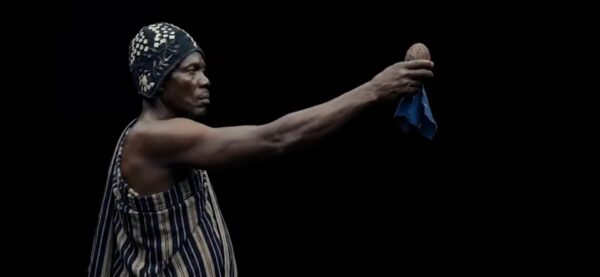
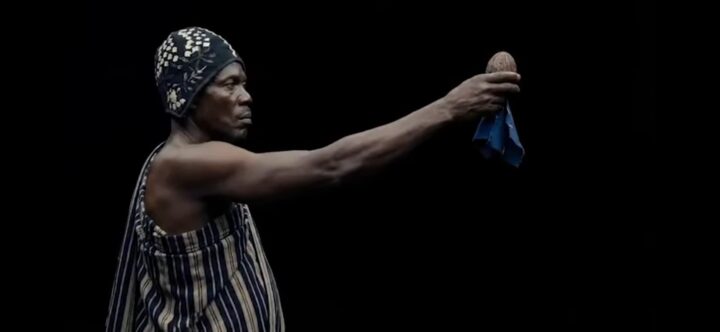
Scene where King Behanzin addressing the Danhomeyan ancestors before meeting with General Colonel Dodds. Holding a palm tree nut and pieces of fabric, he asks the ancestors to unleash hell in France and to its President, if he were not to come back home after negotiating a treaty with French President Sadi Carnot.
In numerous scenes of Behanzin, the Last Roar, the focal point zooms in on the king’s face who is staring at the viewer without even blinking once. The scenes always last for a few seconds long, enough for the viewer to feel involved and hold their gaze as well. This is as if the dialogue, the contact also occurs, silently, on a deep face-to-face, one-on-one. An intimate connection happens then.
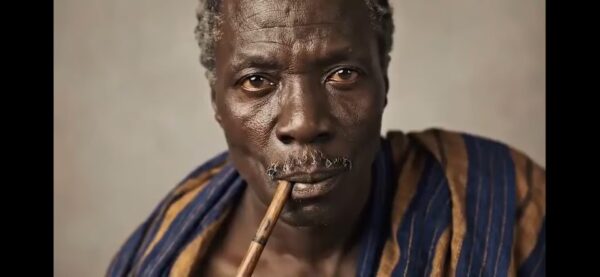
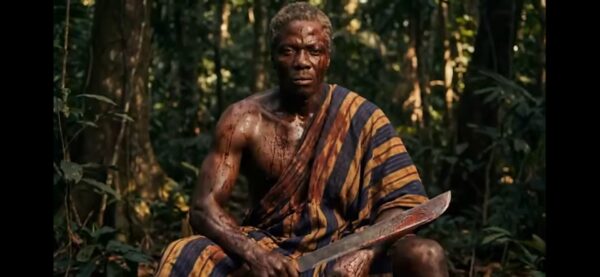
With a severe, insisting facial expression, king Behanzin, at times smoking his pipe, at times holding a bloody machete, symbolizes the gravity of the situation and Behanzin communicating with the spectator.
King Behanzin has, overtime, become a figure who not just belongs or represents the kingdom of Danhomey anymore, but a more global personalization of early major examples of fight to preserve and protect one’s kin, because of its unmeasurable value. He has been quoted alongside other prominent and respected (West) African kings or warriors who chose to sacrifice their lives and reigns rather than give up their people and realm to the French, British or German invaders such as Samory Touré, Chaka Zulu… The name “Behanzin” does not just refer to the fearsome Danhomeyan king, but rather to what the collective memory and imaginary have shaped around the Danhomeyan valiant king (assertion of one’s power and culture, the female warriors, to be invested by a mission to pursue the ancestor’s prowess and achievement). The name “Behanzin” speaks for (west) Africans stiff opposition to the enemy, for safeguarding their pride, battling against territorial, socio, cultural, religious submissions, for relentless assertion of one’s identity and existence, for the invader’s cunning and untrustworthiness. Beninese historian Romuald Michozounou analyzes what resonates when the name of Behanzin is uttered : “Le roi Béhanzin est considéré aujourd’hui non seulement au Bénin, mais dans toute l’Afrique comme un symbole de la résistance africaine et continue d’inspirer la mémoire, l’art et des projets de patrimoine à Dahomey, actuel Bénin et sur tout le continent.” (Today, not only is king Behanzin considered in Benin but also in Africa, as a symbol of African resistance, he keeps inspiring memory, art, heritage projects in Benin, former Dahomey and the entire continent). Even when during the 1970s, Benin was following a Marxist-Leninist political ideology, the President at the time, General Mathieu Kerekou, identified and established king Behanzin as a National Hero.
Whether it is to name schools of higher education, or museums, king Behanzin lays at the basis of sources of inspiration to instill resistance, dignity, opposition, self-esteem and sacrifice for the others. Professor Michozounou concludes that not only should the young generations be inspired by the king’s will to succeed, and his will to use any means possible to achieve one’s goal, his sense of protecting of his own kin and fight to save what can be saved even in an unbalanced situation. But the African continent and people of African descent should continue to remember and celebrate this valiant king. His actions should be a source of motivation for them. They have provided a renewed inspiration for the new visual artistic productions which offer a platform to publicly diffuse new Beninese meanings and interpretations of its own history, memory and identity.
References:
Beni, Barakel. Behanzin, le dernier rugissement (Behanzin, the Last Roar). AI Fiction documentary, 45 minutes. Benin. 2026.
Kouwonou, Isidore. « Béhanzin, le roi que l’histoire refuse d’effacer ». BBC News Afrique, Dakar. 1er février 2026.